For this reason, coming up with effective therapies is paramount.
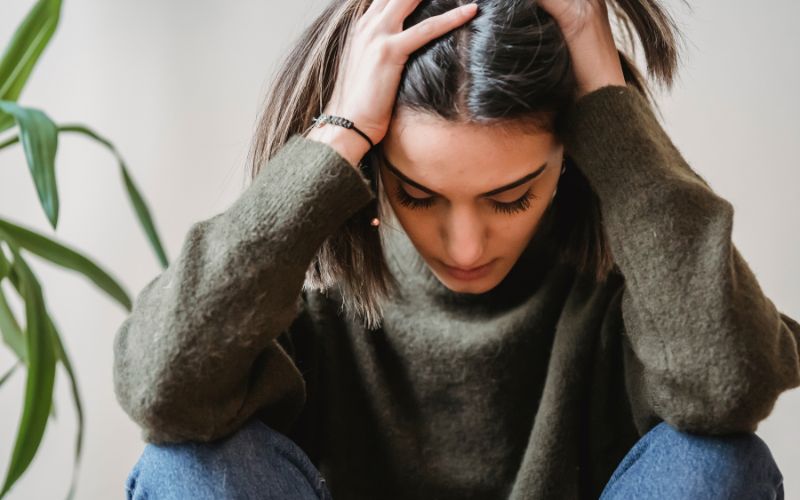
New research points to obstructive sleep apnea (OSA) as a potential culprit for treatment resistant depression and suggests that screening for and treating the sleep condition may alleviate symptoms of depression.
Dr. William V. McCall — chair of the Department of Psychiatry and Health Behavior at the Medical College of Georgia at Augusta University — is the first and corresponding author of the study.
He says, “No one is talking about evaluating for [OSA] as a potential cause of treatment resistant depression, which occurs in about 50% of [people] with major depressive disorder.”
Dr. McCall and team examined the rate of undiagnosed OSA in a randomized clinical trial of people with major depressive disorder and suicidal tendencies.
They recruited 125 people with depression, originally for the purpose of determining if treating their insomnia would improve their depression symptoms.
The original trial excluded people at risk of OSA, such as those taking sleeping pills, or people with obesity or restless legs syndrome.
The scientists tested the participants with a sleep study and found that 17 out of the 125 (nearly 14%) had OSA.
Dr. McCall and colleagues note that people who had OSA did not present with the usual indicators of OSA severity, such as daytime sleepiness. Also, 6 of the 17 people were non-obese women.
This is contrast with the demographic group usually at risk of OSA: overweight men.
“We were completely caught by surprise,” says Dr. McCall, “that people did not fit the picture of what [OSA] is supposed to look like.”
Also, 52 of the 125 participants had treatment resistant depression; 8 of those with treatment resistant depression also had OSA.
The researchers point out that underlying conditions — such as hypothyroidism, cancer, and carotid artery disease — may often be the cause of treatment resistant depression.
Therefore, many people with depression undergo a series of invasive and costly tests in an attempt to figure out the cause of depression treatment failure.
Such tests may include an MRI scan or even a spinal tap — but Dr. McCall and team urge for sleep tests first. “I am thinking before we do a spinal tap for treatment resistant depression, we might need to do a sleep test first,” he says.
“We know that [people] with sleep apnea talk about depression symptoms,” he goes on. “We know that if you have [OSA], you are not going to respond well to an antidepressant.”
“We know that if you have sleep apnea and get [a CPAP machine], it gets better and now we know that there are hidden cases of sleep apnea in people who are depressed and [have] suicidal [tendencies].”
Dr. William V. McCall
However, the study authors also acknowledge that other factors — such as the side effects of other medications, including beta-blockers and corticosteroids — may cause treatment resistant depression.
They also point out that suicidal tendencies are also a key factor, and the researchers suggest that a further area of investigation should be the question of whether or not treating sleep apnea will also reduce suicide ideation.
If you struggle with sleep, chances are you’ve tried it all: eye masks, reducing nighttime screen time, guided meditations, and more. But did you know nutrition can be another tool to help you slumber?
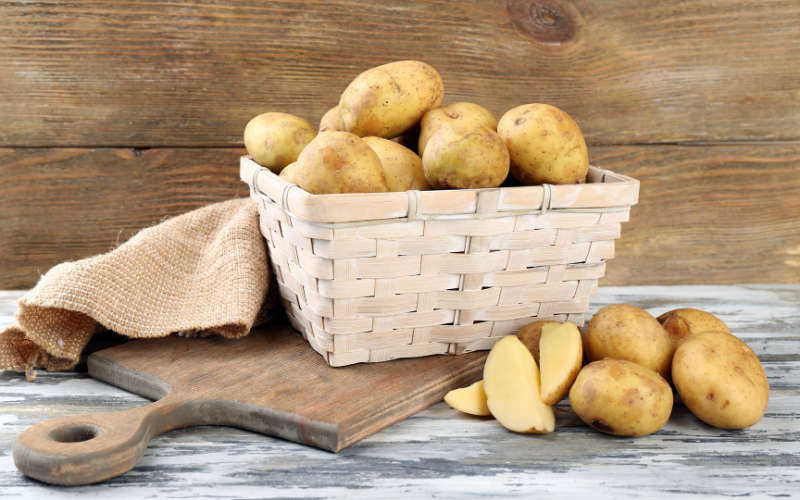
Sweet potatoes, in particular, are a lovely little package of good carbs and sleep-promoting micronutrients. While it may seem like a strange pick, there are a few reasons why potatoes are some of the best foods to eat for better sleep.
1. POTATOES HELP STABILIZE BLOOD SUGAR
A study in the Journal of Sleep Research found carbohydrates were associated with less difficulty staying asleep—but only complex carbohydrates. Complex carbs are carbs composed of fibers and starches (think: the kind you find in whole plant foods such as potatoes and other veggies, legumes, and whole grains). They digest more slowly than the simple carbs present in sugary foods, refined grains, and baked goods. This means complex carbs lead to a slower, steadier rise and fall in blood sugar, not the type of blood sugar surge and subsequent drop that interferes with sleep.
Sugary foods and refined carbs, on the other hand, can cause a blood sugar spike and subsequent drop about four hours later—and this drop is associated with increased production of the neurotransmitter norepinephrine, which promotes alertness. Translation: Not a recipe for good sleep.
2. POTATOESHELP YOUR BODY PREPARE FOR SLEEP
Sweet potatoes still have a moderate impact on blood sugar, but that isn’t a bad thing. In fact, the nutrients they contain make them one of the best tryptophan foods for sleep. “They have the right amount of complex carbohydrates to elicit an insulin response that clears the way for the amino acid tryptophan to flood the brain with less competition from other amino acids,” says Judes Scharman Draughon, MS, RDN, author of 12 Fixes to Healthy. “More tryptophan in the brain helps promote more serotonin production and consequently more of the sleep-enhancing hormone melatonin.”
3. POTATOESCONTAIN SLEEP-SUPPORTING VITAMINS AND MINERALS
Think of sweet potatoes like a natural (and delicious) sleep supplement. “They have the right balance of nutrients like potassium and vitamin B6 to stimulate the production of the sleep hormones serotonin and melatonin,” says Scharman Draughon. Sweet potatoes also contain magnesium, which aids in the production of the neurotransmitter gamma-aminobutyric acid (GABA), which calms nerve activity and helps you relax.
What about white potatoes? They’re not as nutrient-rich, but as long as you’re not eating them in the form of French fries, go ahead and give them a try. “White potatoes produce similar sleep effects as sweet potatoes, but sweet potatoes contain more tryptophan than white potatoes and a nice dose of beta-carotene,” says Scharman Draughon.
HOW TO EAT POTATOES FOR BETTER SLEEP
Whatever potato you choose, don’t eat it too late in the evening. “Eating any food within 60 minutes of going to bed can negatively affect your sleep,” says Scharman Draughon. Your best bet: Incorporate it into your dinner several hours before bed, or (if you’re still hungry) have half a potato as a small late-night snack a bit closer to bedtime.
“Eating a potato for dinner or at least four hours before bed may promote better sleep than eating it an hour before bed,” Scharman Draughon says “It takes time for all these sleep-promoting reactions to occur in the body.” That said, everybody is a little different, so you may need to experiment to find your ideal potato-eating window.
And if you can stomach it, eat the potato skin, too! This provides an extra dose of fiber which promotes balanced blood sugar—and eating enough fiber every day has been associated with improved sleep. Drizzling your baked potato with a little Greek yogurt, olive oil, avocado, or almond butter—all of which provide a dose of healthy fats—helps further stabilize blood sugar and aids in the absorption of fat-soluble nutrients such as beta-carotene (which helps support healthy eyes and skin and a stronger immune system).
THE BEST FOODS FOR SLEEP
Aside from potatoes and sweet potatoes, what are some other healthy bedtime snacks? Here are five foods to eat for better sleep:
OATS
Oats are another complex carb that may have a similar sleep-promoting effect to potatoes. They also produce enough insulin to help clear the way for tryptophan to get to the brain. Plus, they contain a healthy dose of vitamin B6 and melatonin, making them one of the best bedtime snacks. but complex carbs aren’t the only way to enhance sleep.
KIWI
Craving something sweet before bed? Good news: Kiwi is one of the best snacks you can have before bedtime. That’s because they have an unusually high serotonin content, according to Scharman Draughon.
MILK
Turns out, the age-old tradition of having a glass of milk before bed holds up. According to Scharman Draughon, it’s one of the best foods for deep sleep. “Drinking milk in the evening may help you sleep, as it contains a component known as casein trypsin hydrolysate (CTH), which binds to a receptor in the brain to suppress nerve signaling and promote sleep,” she says.
CHERRIES
“Tart cherries, with their high concentration of both melatonin and antioxidant capacity, also enhance sleep,” says Scharman Draughon. In fact, research shows that tart cherry juice before bed improves both sleep duration and sleep quality. Looking for some cherry bedtime snack ideas? Consider making a simple tart cherry smoothie with frozen tart cherries, magnesium-rich almond butter, milk (or non-dairy milk such as almond milk or oat milk), and a bit of easy-to-digest protein like HUM’s plant-based vanilla protein powder, Core Strength. In addition to sleep-promoting micronutrients, this blend contains protein, complex carbs, and fats to promote stable blood sugar.
CHAMOMILE TEA
For something lighter that you can sip closer to bedtime, try chamomile tea. This cozy beverage has been shown to improve sleep quality and quell anxiety, thanks in part to an antioxidant called apigenin, which appears to promote muscle relaxation and sleepiness. For something extra dreamy, try one of these bedtime latte recipes.
KEEP IN MIND, YOUR OVERALL DIET MATTERS THE MOST
While some individual foods may offer sleep-promoting properties when consumed closer to bedtime, your overall eating pattern throughout the day is even more important.
One study in the Journal of Clinical Sleep Medicine found that even just one day of eating low fiber, high saturated fat foods negatively influenced participants’ sleep, in part, by interfering with slow wave sleep, which is considered the most restorative sleep stage. Additionally, eating a higher percentage of calories from sugar and refined carbohydrates was associated with waking up during the night, likely due to fluctuations in blood sugar.
Eating low-fiber, high-sugar, and high-saturated fat foods during the day can also drive your urge for less healthy late-night snacking, which can further interfere with sleep, says Scharman Draughon. At meals, aim for a balance of protein, high-fiber complex carbs (veggies, whole grains, certain fruits), and a healthy source of fat (olive oil, avocadoes, nuts, seeds, salmon).
THE TAKEAWAY
Potatoes, especially sweet potatoes, offer a great combination of complex carbohydrates for steady blood sugar, along with vitamins and minerals that enhance the body’s production of sleep-promoting hormones and neurotransmitters. Try incorporating them into your dinner or a small evening snack for deeper, more restful sleep. Pro tip: Half a baked sweet potato slathered with almond butter and sprinkled with cinnamon is almost like dessert.
Comments Off on How to tell if it’s time for a ‘sleep divorce’
by SadofNE
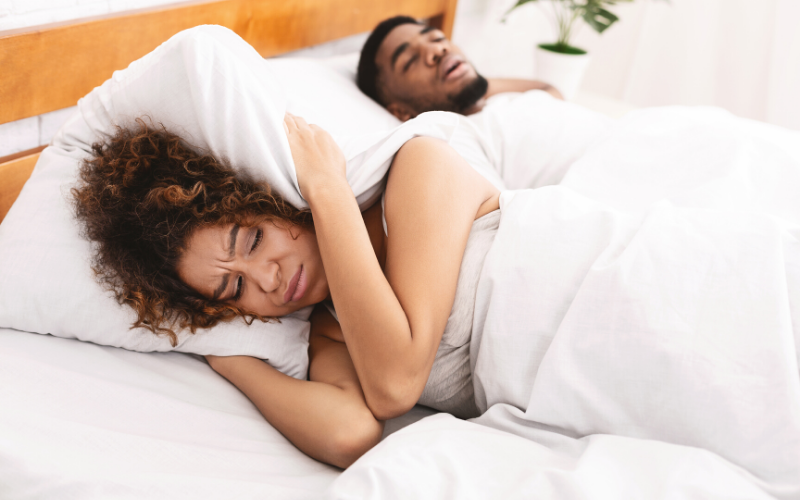
(CNN)He snores until the walls rattle. She gives off a massive amount of body heat. One of you is a cover hog, kicks at night or takes consistent 3 a.m. bathroombreaks. Maybe you sleepwalk or suffer from insomnia. The list of reasons why your bed partner might be keeping you up at night could be long and as dreary as your mood when you drag yourself from bed each morning.
When it comes to your health, that’s nothing to yawn at: Being deprived of a full seven to eight hours of sleep each night has been linked to a higher risk of diabetes, stroke, cardiovascular disease and dementia, according to the US Centers for Disease Control and Prevention.
There’s an emotional toll as well, said sleep specialist Wendy Troxel, a senior behavioral scientist at RAND Corporation who authored “Sharing the Covers: Every Couple’s Guide to Better Sleep.”
“Sleep deprivation can affect key aspects of relationship functioning, like your mood, your level of frustration, your tolerance, your empathy, and your ability to communicate with your partner and other important people in your life,” Troxel said.Poor sleep — and that resulting crummy mood — makes people “less able to engage in ‘perspective taking,’ or putting small adverse events in context,” said sleep specialist Rebecca Robbins, an instructor in the division of sleep medicine for Harvard Medical School, who coauthored the book “Sleep for Success!”
That strain can contribute to depression, anxiety, and other emotional and relationship dysfunction, Robbins said.
Sleep training for adults prevents depression, study findsResearch done by Troxel and her team found that a well-rested person is “a better communicator, happier, more empathic, more attractive and funnier” — all traits that are key to developing and sustaining strong relationships, she said.Sleeping apart can help couples be happier, less resentful and more able to enjoy their time together in bed, particularly on weekends when work demands are lighter, Troxel said.”I tell couples to try to think of it not as a filing for sleep divorce, but as forging a sleep alliance,” she added. “At the end of the day, there is nothing healthier, happier and even sexier than a good night of sleep.”https://www.cnn.com/audio/player?episodeguid=85e00da6-889c-4c66-a203-adb70011ee08&parentOrigin=https%3A%2F%2Fwww.cnn.com&canonicalUrl=https%3A%2F%2Fwww.cnn.com%2F2021%2F12%2F04%2Fhealth%2Fsleep-divorce-wellness%2Findex.html
Rule out underlying sleep issues
Sleep partners are often the ones to flag signs of sleep disorders and encourage their loved one to visit a doctor or sleep specialist. Undiagnosed, sleep disorders may well harm you and your partner’s future health.That’s why experts say it’s best to check with a sleep specialist to rule out and treat any underlying condition before you leave your loved one’s bed — you may well be the key to identifying and treating a true health issue.
Coping skills
Once any serious health issue is ruled out, couples who find it emotionally bonding to sleep in the same bed may wish to try some practical coping tips before making the decision to sleep apart, Troxel said. No alcohol please. If you struggle with insomnia, cut out alcohol well before bed, experts say. It may appear to be helping you sleep, but booze actually causes middle of the night awakenings that can be hard to overcome. Snorers should eliminate alcohol as well, Troxel said, “because as everyone probably knows, if you sleep with a snorer and they have one too many drinks, the snoring will be much worse that night.” That’s because the alcohol further relaxes the throat muscles, encouraging that loud snore.
Keep your brain sharp by finding your sleep ‘sweet spot,’ study saysThis is where partners can be powerful and beneficial sources of what experts call “social control,” Troxel said.”If you’re prone to drinking but you know that the consequences are not only going to bad for your sleep, but your partner’s sleep as well, then maybe you’ll be more motivated to cut back a bit,” she said.Raise the head. For snoring, try sleeping on additional pillows or using an adjustable bed — anything that raises the head to keep the throat open, Troxel said.”For many people snoring tends to be worse when they are flying flat on their backs, so raising the head a little bit can be useful,” she said.If the underlying issue is congestion, try adding a humidifier to the room, she added. “Some people have had success with over-the-counter nasal strips to keep the airway open.”Drown the sound. Survival 101 for dealing with a snoring partner is trying to deafen the noise, Troxel said. Try ear plugs and run a fan or white noise machine.Try sleep scheduling. A snorer who sleeps with a partner with insomnia can help that partner get more sleep by going to bed later than their partner, Troxel said.”For example, a snorer can delay their bedtime by a half an hour to an hour,” Troxel said. “That allows the partner to fall into a deeper stage of sleep and possibly stay that way once the snorer comes to bed.”Turn the snorer. Sleeping on the back is the worse position for snoring, because the soft tissues of the mouth and tongue collapse into the throat. As the sleeper unconsciously forces air past those soft tissues, snores emerge.
How to fall asleep more quickly — the healthy way“If you can keep someone on their side, that can attenuate the snoring,” Robbins said. “I’ve heard of all kinds of creative techniques, such as putting a bra on the snorer in reverse and then putting tennis balls in the cups.”Full support body pillows may be an option, if they stay in place, said sleep specialist Dr. Raj Dasgupta, an associate professor of clinical medicine at the Keck School of Medicine at the University of Southern California.”I’m a fan of the simple things, but if you want to purchase something we’ve come a long way from sewing tennis balls into the back of our pajamas,” Dasgupta said. “You can buy a strap-on to your back that has little protruding foam-like things which are supposed to make you sleep on your side.”And there are some FDA-approved devices that strap to the throat or chest and provide vibrations designed to go off when you are on your back, prompting a move to side-sleeping.”
Time for separate rooms?
You’ve tried it all, and good sleep is still a distant dream. At this point, there’s no reason not to do what is best for each of you to get the quality sleep you need — especially since there are other ways to nurture a relationship besides sharing a bed.
The best alarm clocks of 2021 (CNN Underscored)“Couples can still make the bedroom a sacred space, even if they choose not to actually sleep together,” Troxel said. “You can develop pre-bedtime rituals and use that time to actually connect with your partner instead of being independently on a phone or laptop or whatnot. “She encourages couples to spend quality time together before bed, sharing details of the day and sending positive messages to each other. “We know self-disclosure is good for relationships, it’s good for sleep,” Troxel said. “If you tell your partner you’re grateful for them, that’s a deep form of connection. Gratitude is good for relationships, it’s good for sleep.”
Nor does a “sleep divorce” have to mean separate beds every night, Troxel said. It could be just the workweek, with weekends spent in the same bed. It could be every other night — the options are as unique as each couple. “There truly is not a‘one-size-fits-all’ sleeping strategy for every couple,” Troxel said. “It’s really about finding the strategy that’s going to work best for the two of you.”
Comments Off on Sleep-disordered breathing tied to greater preeclampsia risk
by Vicki Cohn
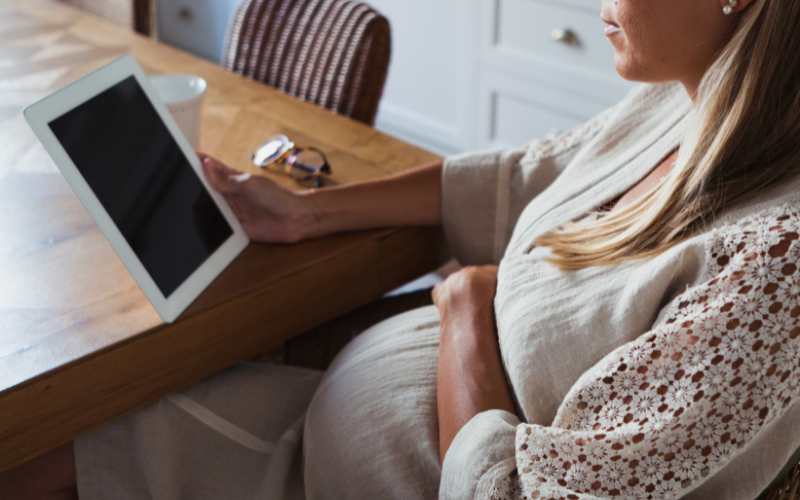
Women with high-risk pregnancies who experience sleep-disordered breathing have an increased risk for preeclampsia, according to a study published in the American Journal of Obstetrics & Gynecology.
The prospective observational cohort study involved women with high-risk singleton pregnancies, author Stella S. Daskalopoulou, MD, MSc, PhD, of the department of medicine’s division of internal medicine at McGill University Health Centre in Montreal, and colleagues reported in the study.
High-risk factors included age of at least 35 years, BMI of at least 25 kg/m2, chronic hypertension, pre-existing diabetes or renal disease, conception via in vitro fertilization and personal or first-degree relative family history of preeclampsia.
Of the 235 women recruited between 10 and 13 weeks of gestation at two tertiary obstetric clinics in Montreal, 181 women completed questionnaires about their sleep based on the Epworth Sleepiness Scale, Pittsburgh Sleep Quality Index and restless legs syndrome during each trimester.
Women identified with sleep disordered breathing (SDB), defined as three or more incidences of loud snoring or witnessed apneas each week, in the first or second trimester were diagnosed with mid-gestation SDB. Women identified with SDB in the third trimester were diagnosed with late-gestation SDB.
The researchers also conducted arterial stiffness, wave reflection and hemodynamic assessments between 10 and 13 weeks and again six more times at approximately 4-week intervals through the rest of the pregnancy.
Carotid-femoral pulse wave velocity (cfPWV), which is considered the gold standard for predicting arterial stiffness and is predictive of preeclampsia, and carotid-radial PWV were calculated to determine aortic and peripheral arterial stiffness, respectively.
According to the study, the 41 women (23%) who had SDB also had increased cfPWV across gestation independent of blood pressure and BMI (P = .042). Also, only women with SDB saw an association between excessive daytime sleepiness and increased cfPWV.
After 20 weeks’ gestation, women who had BP of at least 140 mm Hg/90 mm Hg were diagnosed with preeclampsia.
Women with mid-gestation SDB had an OR of 3.4 (95% CI, 0.9-12.9; P = .063) for preeclampsia, which increased to an OR of 5.7 (95% CI, 1.1-26; P = .028) for women who also experienced hypersomnolence. Women with late-gestation SDB had an OR of 8.2 (95% CI, 1.5-39.5; P = .009) for preeclampsia.
Additionally, the researchers reported a positive association between excessive daytime sleepiness and central arterial stiffness in women with SDB but not in women who did not have SDB. Women who reported SDB and excessive daytime sleepiness appeared to have a greater risk for preeclampsia than women with SDB alone as well.
However, women who had positive restless legs syndrome scores did not see increased odds for developing preeclampsia either in mid-gestation (OR = 1.23; 95% CI, 0.25-4.68) or late gestation (OR = 1.01; 95% CI, 0.21-3.75). The same held true for women who had positive Pittsburgh Sleep Quality Index scores in mid-gestation (OR = 2.11; 95% CI, 0.58-8.66) or late gestation (OR = 2.83; 95% CI, 0.65-19.81).
Overall, the researchers said, there was an association between SDB in the first or second trimester and greater central arterial stiffness starting at 10 to 13 weeks’ gestation for women with high-risk pregnancies.
Further, the researchers said, their results provide supporting evidence for arterial stiffness as an important mediator and promising surrogate endpoint for vascular dysfunction in preeclampsia, as well as for the need to screen for SDB throughout pregnancy.
You’re probably aware of how life-threatening sleep apnea can be. It has been linked to anything from stroke and heart attack to some types of cancer. But according to a new study published in the American Journal of Respiratory and Critical Care Medicine, there is one scenario in which having sleep apnea can be tremendously beneficial.
Sleep Apnea can actually save your life!
These scientists picked two groups of mice and divided them by age into a group roughly corresponding to the same age as human teenagers and another group corresponding to humans age 65 and older. When comparing the two groups, they could clearly see that the intermittent lack of oxygen involved in sleep apnea sped up tumor growth in the young mice, although this did not occur in the older mice. So age seems to be a protective factor against aggressive tumor growth that is caused by intermittently low oxygen levels.
They couldn’t elucidate why this happens, except to suggest that immune system cells inside the tumors within young and old bodies respond differently to low oxygen conditions.
Immune system cells called macrophages are present in tumors; they are often responsible for most of the inflammation that occurs in these tumors. For a reason that remains poorly understood, these macrophages are not as aggressive in older bodies as they are in younger ones when responding to a low-oxygen environment.
This might be why previous studies on the association between sleep apnea and cancer have been rather mixed. If age affects the relationship, then different studies will reach different conclusions.
Another factor that might have confused researchers is that different types of cancer respond differently to the lack of oxygen. Researchers from the University of Barcelona specifically looked at lung cancer, but other cancers may not necessarily respond the same way.
This new study might thus clear up some of this confusion with its finding that the bodies of cancer sufferers at different ages may respond differently to intermittent oxygen deprivation.
Regardless of age or other factors, cancer is probably the least of your worries if you suffer from sleep apnea, as there are more urgent complications connected to this disease.
We’ve all had those nights where we inexplicably wake up in the middle of the night with a grumbling belly. Maybe it was that HIIT workout you braved for the first time, your marathon of meetings-slash-evening-errands that left you with little time to eat an adequate dinner, or maybe you were just dreaming about delicious pasta (the best type of reverie).
While you could certainly go forth and eat gobs of Nutella straight from the jar—convenience and tastiness are both extremely key, after all—you don’t need to be an registered dietitian to conclude that the sugar content isn’t exactly a recipe for sound sleep the rest of the night. “High fat and high sugar foods like ice cream and cookies are a double whammy of not helping you sleep well, because fat takes a long time to digest,” says Dawn Blatner, RDN, author of The Superfood Swap. “Giving your gut foods that are difficult to digest distracts your body from sleep, and then sugar causes spikes and crashes of blood sugar and those will interrupt sleep, too.”
Blatner also suggests avoiding alcohol since, even though your nightcap can make you feel sleepy, it will disrupt your sleep cycle later in the night and lead to lower quality sleep. Caffeinated teas or too much of anything liquid should also be consumed in moderation, she adds, as having to use the bathroom can keep you awake.
7 healthy midnight snacks that will help lull you back to sleep
1. Tart Cherries
“Tart cherries are a natural source of melatonin, a hormone that regulates the body’s internal clock and sleep-wake cycle,” says Blatner. If you can’t find tart cherries at the supermarket, she suggests opting for tart cherry concentrate, which is the super-charged version of tart cherry juice with two tablespoons packing in the equivalent of a whopping 60-plus cherries. Instead of guzzling it (remember that sugar and excessive amounts of liquid can keep you awake), create yourself a little ‘natural’ jello shot before bed. “All you do is mix two tablespoons of tart cherry concentrate with a tablespoon of chia seeds and chill it in the fridge. Try topping it with greek yogurt to combat the tartness,” Blatner says.RELATED STORIES‘I’m a Registered Dietitian, and This Is the One Food I Always…Why Snacking on Hemp Seeds Can Help You Sleep More Soundly
2. Pumpkin Seeds
“Pumpkin seeds are an excellent source of magnesium, and studies have found that magnesium improves insomnia and sleep efficiency,” says Blatner. Almonds, cashews, and peanuts are other good sources of magnesium that all make for ideal healthy midnight snacks.
3. Cottage Cheese
Cottage cheese contains the amino acid L-tryptophan. “Tryptophan plays a role in the production of serotonin, a neurotransmitter that’s associated with healthy sleep,” says Blatner. “Research has found people who ate cottage cheese about 30 minutes to an hour before going to bed experienced better metabolic health, muscle quality, and overall health than people who didn’t.”https://79dbc014217aa09ddae4500b65493fc3.safeframe.googlesyndication.com/safeframe/1-0-38/html/container.html
We know it’s no cheesy mozzarella pizza or ricotta cheesecake, but you can optimize your enjoyment of cottage cheese with a sprinkle of cinnamon (which has its own sleep benefits). “You can also try topping it with tahini or sunflower seed butter, which both contain tryptophan as well,” says Blatner.
“Research suggests that the antioxidants and natural serotonin in kiwis can improve both sleep quality and quantity,” says Blatner. Kiwis are naturally sweet and delicious as-is, but you can jazz them up by lightly dipping them in dark chocolate. “Dark chocolate has magnesium, a helpful sleep mineral, but it also has a little caffeine, so go easy on it.”
6. Banana with Peanut Butter
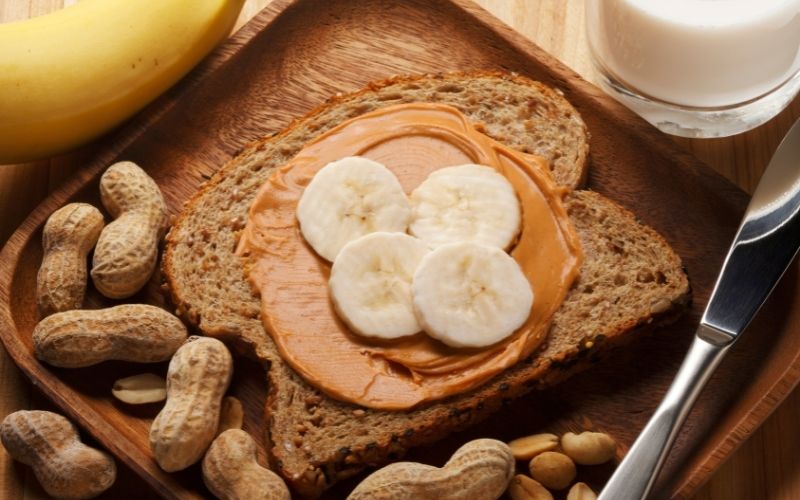
“Foods that contain unsaturated fats, like peanut butter, can help improve serotonin levels and boost satiety to keep you feeling satisfied and full during sleep,” says Carissa Galloway, RDN, a nutrition consultant at Premier Protein. “Eating bananas with peanut butter can also be helpful before bed, as bananas contain magnesium which, as mentioned, help support good sleep.” The combination of bananas plus peanut butter makes for one of the most delicious healthy midnight snacks out there.
7. Chamomile Tea
“There are numerous studies that support the benefits of chamomile tea in promoting a healthy nighttime routine,” says Galloway. Chamomile tea contains flavonoids, which are compounds found in certain foods, including one called apigenin. “Apigenin connects with receptors in our brains to help reduce insomnia and promote a state of steady sleep.”
So when you find yourself wide awake in the wee hours, sip a cup of chamomile tea with a splash of steamed almond milk, or have a batch of Blatner’s chamomile cookies on hand.
All that said, bear in mind that more important than what you eat before bed, is the amount. “Having a large amount of any food will take too much effort for your body to digest instead of resting,” says Blatner. A light nosh of one of the foods recommended here, on the other hand, will send you right into the sweetest of dreams.
To provide the best experiences, we use technologies like cookies to store and/or access device information. Consenting to these technologies will allow us to process data such as browsing behavior or unique IDs on this site. Not consenting or withdrawing consent, may adversely affect certain features and functions.
Functional
Always active
The technical storage or access is strictly necessary for the legitimate purpose of enabling the use of a specific service explicitly requested by the subscriber or user, or for the sole purpose of carrying out the transmission of a communication over an electronic communications network.
Preferences
The technical storage or access is necessary for the legitimate purpose of storing preferences that are not requested by the subscriber or user.
Statistics
The technical storage or access that is used exclusively for statistical purposes.The technical storage or access that is used exclusively for anonymous statistical purposes. Without a subpoena, voluntary compliance on the part of your Internet Service Provider, or additional records from a third party, information stored or retrieved for this purpose alone cannot usually be used to identify you.
Marketing
The technical storage or access is required to create user profiles to send advertising, or to track the user on a website or across several websites for similar marketing purposes.